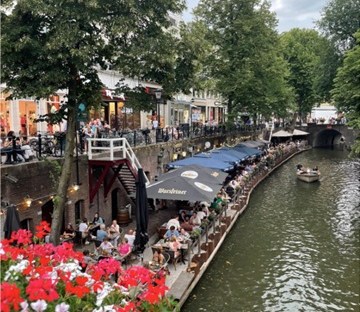
Niranda Morris, a Queen Mary University of London MA Heritage Management student, reflects on her Summer in Utrecht, Netherlands and how she learnt to live life in slow lane.
In Utrecht, the canals aren’t just pretty backdrops, they are part of everyday life, someone’s front porch, a workplace, a spot to meet friends. I’d seen canals in other cities, but here they felt alive, woven into the rhythm of the community. The gentle water seemed to slow everything down, inviting me to notice details I might otherwise have rushed past. That sense of presence is what I’ve come to associate with Utrecht, slow living in its purest form.


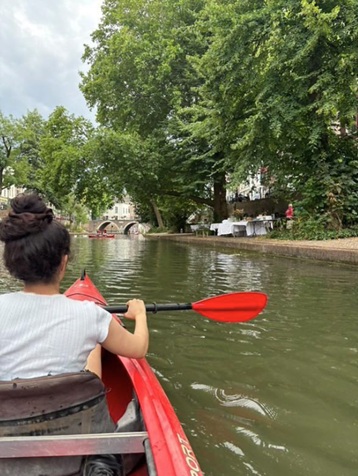
Utrecht taught me the value of taking my time, of appreciating the small things; and in a world where everything moves fast, I decided to embrace the pace of the city. Sometimes, I walked without a destination, down the medieval streets, feeling as if I’ve stepped back in time. I could almost imagine merchants hauling goods from boats onto the cobbled streets. But Utrecht isn’t just a relic of the past, it’s a city that’s found a way to balance history and modern life. Students lounge by the canals, friends gather for drinks on the terraces, and locals ride past with their groceries. There’s a thriving community here that, while appreciating their history, embraces the future.
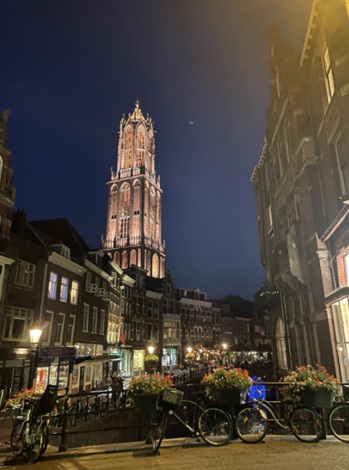
One morning, I decided not to make any plans at all and simply see where the day took me. I wandered aimlessly throughout the historic centre, stumbling upon a tiny bakery tucked between two narrow brick terraces. From there, I ventured into an old bookstore, where the owner shared stories of how Utrecht has changed over the decades. At one point, I found myself standing in the shadow of the Dom Tower, listening to its bells ringing out over the rooftops. A few days later I decided to climb the Tower. The view was exceptional, the landscape full of winding canals and distant green fields; the narrow streets looked like it was part of a tiny miniature village. In moments like these, I couldn’t help but feel that the world had slowed down, allowing me to truly take it all in.

Art history offers a framework for understanding this kind of presence. The Netherlands has an incredibly rich artistic heritage and you can feel its influence in every corner of its cities. During my visit to Leiden I found myself captivated by the legacy of the Dutch Golden Age. Artists like Rembrandt and Vermeer transformed everyday life into something timeless. Their work focused on realism and the use of light, qualities I began to notice more around me, like the way sunlight poured over the canals, or how people sat in quite reflection by the water. These moments suddenly felt like scenes lifted from a Golden Age painting. Later, in Amsterdam, I visited museums that showcased the bold emotional brushwork of Vincent van Gogh whose work marked a shift toward post-impressionism. His paintings full of emotion made me think about how we interpret the world – not only visually, but also with feelings and connections.
Encountering the work of Vincent van Gogh expanded this idea of presence. If the Golden Age represented visualisation, Van Gogh represented seeing with emotion. His brushwork and colour suggest not only what is visible but how it feels to inhabit a moment. This emotional intensity reframes presence as more than observation; it is also affective participation. Back in Utrecht, I became aware of how colour, atmosphere and movement shape experience.
One of the greatest advantages of staying in Utrecht is how connected the city is. With the train station at its heart, I could easily spend a day in Amsterdam, Rotterdam, Leiden or The Hague and still return that evening. I especially loved visiting Leiden; a compact, walkable city steeped in artistic history. Each trip offered something new from museum visits to unexpected conversations and the efficiency of Dutch trains meant travel never felt rushed.
Of course, living abroad also came with practical challenges mainly surrounding finances, but with financial support from Queen Mary and careful budgeting, I was able to enjoy the city without constant stress. Without the GO Summer bursary or the Turing Scheme grant I would have found it very difficult to spend a month abroad; funding made it possible to fully embrace what my course and the country had to offer. Utrecht isn’t the cheapest city so I had to keep a log of all my purchases, allowing me to be more mindful when spending. But many of the best moments, like buying fresh pastries, or sitting by the canals, cost very little.


By the end of my stay, Utrecht had become more than a city to me, rather a lesson. Its canals, streets and history taught me that attention isn’t passive, but a choice. You can rush through places and moments, or you can live them slowly, noticing details that make them unforgettable. Back home, I hope to carry a little bit of this with me, to wander more without purpose, to find joy in small encounters and to remember that sometimes the best way to see the world is not to move faster, but to slow down.
 Queen Mary Global Bloggers